Thursday, 8 May 2014


Δελτίο Τύπου - Press Release
Δελτίο Τύπου

Το Δίκτυο Νέων
Ελλάδας (Youthnet Hellas), σε συνεργασία με την Κίνηση Νέων Έδεσσας, το ΚΕΣΥΠ Έδεσσας και
την “Επί Σκοπόν”, υλοποίησαν με ιδιαίτερη επιτυχία Ευρωπαϊκό
Πρόγραμμα Δια Βίου Μάθησης (“Νέα Γενιά σε
Δράση”) στην Έδεσσα στο χρονικό
διάστημα 22.04-29.04 του 2014.
Στο Πρόγραμμα
συμμετείχαν 32 Νέοι από 6 χώρες της Ευρωπαϊκής Ένωσης (Ιταλία, Ισπανία, Εσθονία, Πολωνία, Βουλγαρία, Ελλάδα), με
αντικείμενο μελέτης και ανάλυσης τις μη μεταφράσιμες λέξεις που υπάρχουν στο
λεξιλόγιο των χωρών που εκπροσωπούνται. Κύριος στόχος του προγράμματος ήταν η
διαπολιτισμική κατανόηση και μάθηση και η εξοικείωση των συμμετεχόντων με
διαφορετικές κουλτούρες και πολιτισμικά χαρακτηριστικά μέσω αυτών των
ιδιαίτερων λέξεων που υπάρχουν σε κάθε γλώσσα.
Οι συμμετέχοντες παρουσίασαν
τις μη μεταφράσιμες λέξεις των χωρών τους, εξήγησαν το νόημά τους και πραγματοποίησαν
διάφορα εκπαιδευτικά εργαστήρια και δραστηριότητες σχετικά με το θέμα αυτό. Τα
εργαστήρια, οι συζητήσεις και οι δραστηριότητες διεξήχθησαν στο πλαίσιο της μη
τυπικής και άτυπης μάθησης, με σύγχρονες εκπαιδευτικές μεθόδους, διαδραστική
προσέγγιση και ενεργή συμμετοχή όλων των συμμετεχόντων. Στο τέλος του
προγράμματος συγκεντρώθηκε όλο το υλικό και δημιουργήθηκε από τους
συμμετέχοντες το «Εγχειρίδιο Μοναδικών
Λέξεων», το οποίο περιλαμβάνει όλες τις λέξεις που παρουσιάστηκαν και
αναλύθηκαν, μαζί με εξήγηση του νοήματός τους και γραφιστική απεικόνιση.
Το πρόγραμμα αυτό
ανταλλαγής νέων ήταν το πρώτο που διεξήχθη στην πόλη της Έδεσσας και η επιτυχία
του γέμισε με ενθουσιασμό τους βασικούς συντελεστές του (Δίκτυο Νέων Ελλάδας
& Κίνηση Νέων Έδεσσας) και τα άτομα που εργάστηκαν σκληρά για τη διοργάνωση
και υλοποίησή του. Όλη η προσπάθεια έγινε σε εθελοντική βάση και με απώτερο
σκοπό την αφύπνιση και ενεργοποίηση των Νέων της Έδεσσας και του Ν. Πέλλας και
την ενίσχυση της εξωστρέφειας της περιοχής.
Οι ενδιαφερόμενοι
μπορούν να παρακολουθήσουν την πορεία του project και το
οπτικοακουστικό υλικό που έχει αναρτηθεί στην ειδική ιστοσελίδα για το
πρόγραμμα ανταλλαγής (http://spread-the-word-2014.blogspot.gr/)
και στην επίσημη ιστοσελίδα του Δικτύου Νέων Ελλάδας (www.youthnet.gr). Οι ιστοσελίδες
θα ενισχυθούν σύντομα με πλούσιο υλικό και θα αναρτηθεί και θα διατεθεί δωρεάν
για το κοινό σε ηλεκτρονική μορφή και το «Εγχειρίδιο Μοναδικών Λέξεων» (“Handbook of Unique Words”).

Press
Release
Report
on the Youth Exchange program “Spread the Word, Feel the World”, in the frame of
the European “Youth in Action” program.
Youthnet Hellas, in
collaboration with the Youth Movement of Edessa, have successfully implemented a
European Lifelong Learning Program (“Youth
in Action”) in Edessa, from the 22nd till the 29th
of April 2014.
32 people from 6 European
countries (Italy, Spain, Estonia, Poland, Bulgaria and Greece) participated
in this program. The topic was the study and analyzing of untranslatable words
in each language of every represented country. The main aim of the program was
intercultural understanding and learning amongst participants and to
familiarize them with different cultures and cultural elements of participating
countries, with the help of unique words that are existent in each language.
The participants presented
the untranslatable words of their countries, explained their meaning and participated in various workshops and activities
concerning this topic. The workshops, conversations and activities were
conducted in the frame of non-formal and informal learning, with modern
educational methods, interactive approaches and active participation of all
participants. A “Handbook of Unique Words”, which contains all the words that
were discussed and analyzed with their explanations and illustrations, was
created by the participants at the end of the program.
This Youth Exchange was the
first to take place in the town of Edessa, and its
success filled the organizers (Youthnet Hellas & Youth Movement of Edessa)
and all the others who worked hard for its realization, with joy and a lot of
enthusiasm. All the effort by organisers was on a voluntary basis, with an
upper aim to wake and activate the youth of Edessa and the county of Pella and to make
this small area more extroversive and international.
The course of the project
and its audiovisual material can be viewed on the special website of the youth
exchange (http://spread-the-word-2014.blogspot.gr/) and on the
official Youthnet Hellas website (www.youthnet.gr).
They can also read and download for free the “The Little Handbook of Unique Words”, which was created during the youth exchange and constitutes a deliverable of the programme.
They can also read and download for free the “The Little Handbook of Unique Words”, which was created during the youth exchange and constitutes a deliverable of the programme.


Monday, 5 May 2014
Spread the Word, Feel the World: An Introduction
It is commonly known that the language we speak represents our horizons as a person. It defines us and teaches us about the world around us, while also helping us to communicate with each other in a mostly efficient way. There are no higher or underdeveloped languages; there are no languages that are ‘better’ than other languages. All languages are created equal, as pretty much everything else on this planet we call home. However, it’s humanity that comes up with discrimination against things it doesn't understand; which also leads to fear.
Since all languages are equal, all languages are perfect; of course they are only perfect for the people who speak them. A foreign language, when put in a different country than its origin, is pretty useless, because no one speaks that foreign language; so it kind of defeats the purpose, which is to communicate. Languages were created by humans so we could communicate with each other and express our needs, longings and feelings. There is no other use for language besides that.
Languages try to describe reality. Do they succeed in that endeavor?
No, they don’t.
No, they don’t.
If languages actually successfully described reality then there would only be one language. You see, ‘reality’ is nothing more than the things you see around you and the things you experience. Reality is something very subjective and, since language is created to aid humans, language is subjective as well. The languages describe what they see in the country in which they were created. For example, the Eskimos have about a 100 different words for ‘snow’, but the Greek language has only one (χιόνι /chi’oni/ ). Now, why might that be? Eskimos are surrounded by snow; snow is their view of reality and because they see and use it every day, they have found many words to describe it. Greece, on the other hand, is a southern and warm place with little to no snowfalls every winter. As such, there was no need to have a 100 different words for ‘snow’ so they only created as many as they needed in order to communicate amongst themselves the idea of that white, cold and watery thing that sometimes falls during the winter… especially on the mountains….χιόνι.
But the secret lies in the word ‘try’. Languages try to describe reality, and that is a good thing. Through the process of trying to describe reality in order to communicate, languages were created and even to this day new words are added to most vocabularies. For example, English has the greatest influx of foreign words, mainly because so many people from different countries speak it. As a result, the reality of a native English speaker has expanded dramatically over the years as words were added. This is the reason to learn a new language; to expand one’s horizons. Languages allow us to explore and view the world through a different lens, creating a better understanding and tolerance for foreign cultures and habits. Languages are a gateway to new worlds; through them, we learn how other people in other countries think, feel and behave. They provide us with new experiences and new lives, for through languages, we are able to dive into new nations and adopt parts of their cultures making them our own, and thus, becoming a part of those cultures ourselves. Languages shape our personalities and mindsets, allowing us to break free from the borders of our own country to become citizens of the world.
Languages do not discriminate, or hate; they only serve our communication. It is up to us to use them as tools to create a better and unified world.
“Spread the word, feel the world” is a unique Youth Exchange, consisting of 32 people from 6 European countries (Bulgaria, Estonia, Italy, Poland, Spain and Greece) who came together at the 22nd of April in Edessa, Greece to discuss about the untranslatable word of their languages. For one week the participants worked together, joining their diverse cultural backgrounds to create a better understanding of the world around them, reforming their perception of it. The result of this collaboration can be viewed in this Handbook of Unique Words, which illustrates words that are unique in their own right because of the varied historical and cultural events that created them.
April, 2014
Tuesday, 29 April 2014
Day 5
Back
to the kindergarden

 Today, as always, we learned about many interesting things in a non-formal way. At the begging we were focusing on the Erasmus+ program (BIG thanks to Ewa for her great presentation). We were divided into groups, fortunately all of them managed to achieve the tasks, which weren’t so easy actually.


Today, as always, we learned about many interesting things in a non-formal way. At the begging we were focusing on the Erasmus+ program (BIG thanks to Ewa for her great presentation). We were divided into groups, fortunately all of them managed to achieve the tasks, which weren’t so easy actually.
After a coffee break we started with European Union institutions. Natasha prepared the classes for us (also BIG thanks to her!) and there were really stimulating discussion between the participants about how important is to vote in the next EU elections and in general. We found out that discussion about important topics is the best way to become more confident among each other. We think those moments will stay in our memories forever. We’re really happy that we have the opportunity to meet so many intriguing people.
Before the lunch, we organized our job to finish the handbook of unique words. Once again we worked in the national teams preparing the final version of our list of words.
We had great fun in the evening while we were tasting the greek pizza and dancing. The pizza was really delicious as all the greek food we were tried in those days.
Monday, 28 April 2014
Day 4
Like everyday we started with an energizer.
After that there was a presentation about
the linguistic aspects. During the
morning session we were divided into different
groups and had to create new words from those who are not translatable
in our languages by using different methods. We found out really good words ( for example –
“to yonch”, which means wandering around). We've got free afternoon.


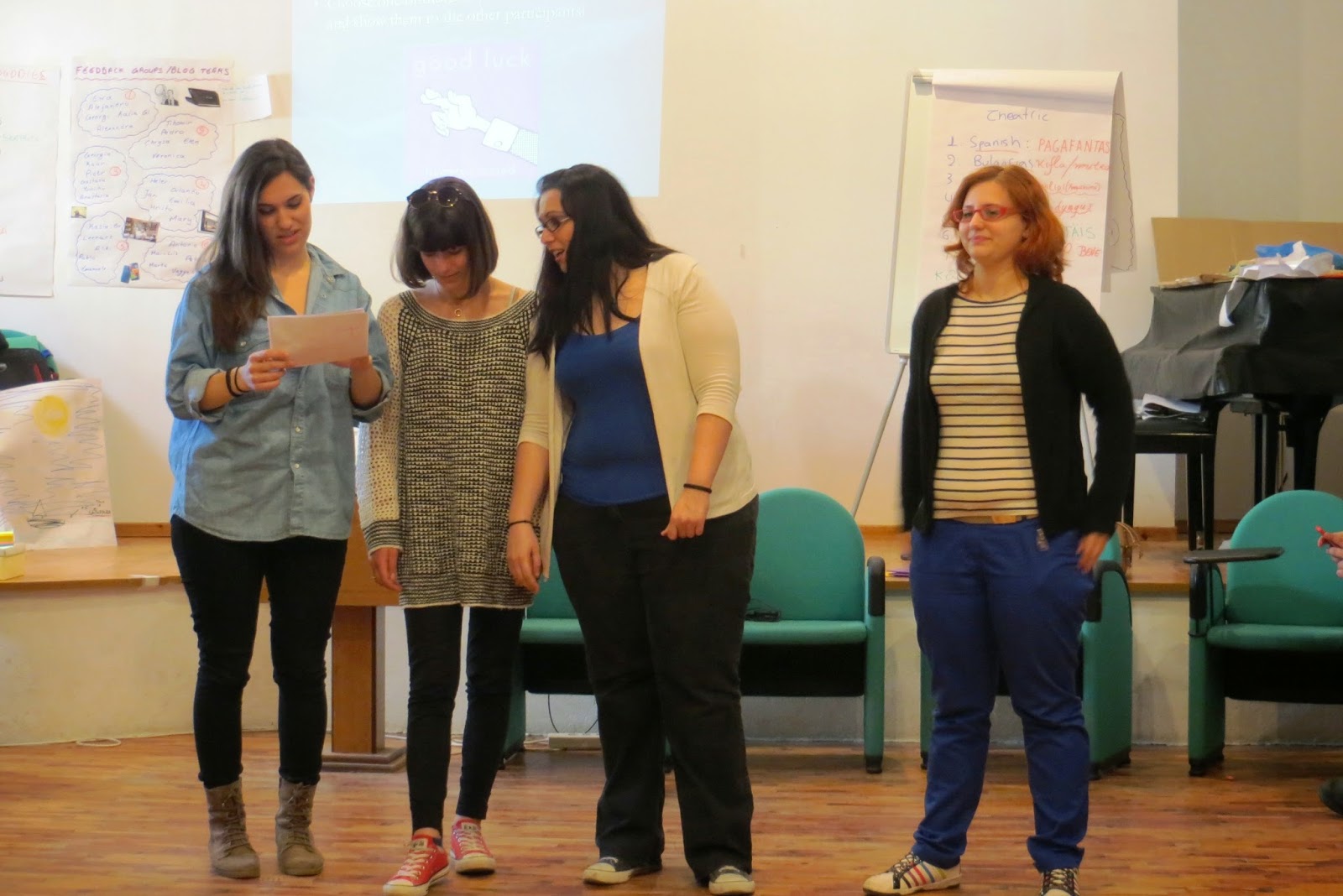


After giving to all the participants a funny questionnaire we collected all the data and found out who are the winners in 7 categories. During the dinner we decided to announce the results.
1st category
The most beautiful person
We've got two beautiful women
Veronica

and Chrysa


2nd category
The most beautiful smile - Chrysa
3rd category
The most funny person - Gustavo


5th category - flirty person - also Pedro

6th the most angelic person - Beatrice unfortunately we don't have a picture but she has beautiful picture with Orlando.
7th the most attractive couple
Kasia i Piotr


After giving to all the participants a funny questionnaire we collected all the data and found out who are the winners in 7 categories. During the dinner we decided to announce the results.
1st category
The most beautiful person
We've got two beautiful women
Veronica
and Chrysa

the most handsome man - Orlando :-)
2nd category
The most beautiful smile - Chrysa
3rd category
The most funny person - Gustavo
4th category - party animal - Pedro
5th category - flirty person - also Pedro
6th the most angelic person - Beatrice unfortunately we don't have a picture but she has beautiful picture with Orlando.
7th the most attractive couple
Kasia i Piotr
Beatrice and Orlando
Alexandra and Kaur
Subscribe to:
Posts (Atom)